
Quick Answer
Mindfulness reminders throughout the day work best when they're ambient rather than loud — a calm phrase you glance at, not one more notification to swipe away. The aim is simple: interrupt autopilot a few times a day and return to the present. Tie each cue to something you already do, and keep it somewhere you can't avoid looking.
What Mindfulness Reminders Throughout the Day Actually Do
Most of the day runs on autopilot. You drive home and don't remember the drive; you eat lunch over a screen and don't taste it; you finish an hour of work and can't say where it went. Mindfulness reminders throughout the day are small, deliberate interruptions to that autopilot — a cue that says, in effect, come back. Notice your breath. Feel your feet. Drop the shoulders you've been holding by your ears since 9 a.m. They aren't about bolting a meditation session onto an already-full calendar. They're about catching the ordinary moments you'd otherwise sleep through, and they work precisely because they're tiny and frequent rather than long and rare.
Harvard psychologists Matthew Killingsworth and Daniel Gilbert sampled 2,250 adults at random moments through a smartphone app and found people's minds were elsewhere about 47% of the time — and that a wandering mind reliably predicted being less happy in that moment (Science, 2010).
That study — A Wandering Mind Is an Unhappy Mind — is the whole case for mindfulness reminders in one number. Nearly half your waking life is spent somewhere other than where you actually are, and those detours tend to drag mood down, not up. A reminder is just a small bell that interrupts the wandering and hands you back the present moment. You don't need to catch all 47% — catching it five or six times a day, gently, is enough to change how a day feels. The hard part is building a cue you won't quietly tune out.

Why Notifications Make Terrible Mindfulness Cues
The obvious move is to set a recurring notification: a 'breathe' alert every two hours. It works for about a week. Then your brain files it under the same category as every other banner — Slack, email, the weather app being dramatic — and starts dismissing it before the words even register. Psychologists call this habituation: a stimulus that repeats without consequence fades into background noise. Worse, a buzzing reminder to relax is faintly stressful in itself, one more thing demanding a response. The cue that's supposed to calm you becomes part of the pile you're trying to escape.
- •
A good cue is ambient, not interruptive. You should be able to glance at it and look away — not have to tap, dismiss, or respond.
- •
It's tied to something you already do. Unlocking your phone, sitting down, waiting for the kettle. Anchors carry the remembering so you don't have to.
- •
It's gentle, not corrective. 'Breathe' beats 'Why are you so tense again?' A cue that shames you gets avoided like any other unpleasant task.
- •
It changes occasionally. The same words in the same spot eventually go invisible. A cue you can refresh keeps catching the eye.
- •
It lives where your attention already goes — not buried in an app you have to remember to open.
Mindfulness Cues Worth Trying
You don't need all of these — pick one or two and let them become automatic before adding more. Each one anchors a thirty-second reset to a moment that already happens dozens of times a day, so the timing takes care of itself.
- •
One breath at the doorway. Every time you walk through a doorway, take a single slow breath. Doorways happen constantly and make a perfect built-in timer.
- •
Feet on the floor when you sit. As you sit at your desk, feel both feet flat on the ground. It pulls attention out of your head and into your body in two seconds.
- •
Box breathing at red lights. Inhale four counts, hold four, exhale four, hold four. A red light is dead time you can repurpose into a reset.
- •
Unclench at every unlock. Each time you pick up your phone, drop your shoulders and unclench your jaw. You unlock dozens of times a day — that's dozens of micro-resets.
- •
A single word on your lock screen. 'Here.' 'Breathe.' 'Soften.' One word you'll see every time you glance down, doing the reminding without a single notification.
💡 Tip
Anchor cues to transitions, not clock times. A 2 p.m. alert competes with whatever you're already doing at 2 p.m. and usually loses. 'When I sit down' or 'when I unlock my phone' fires at a natural seam in the day, when your attention is already shifting — so the reset slots in instead of fighting for space.

Put the Cue Where You Already Look
Here's the catch with everything above: a mindfulness practice that depends on a meditation app, a habit tracker, and a stack of recurring alerts asks you to manage four systems just to remember to breathe — and managing systems is exactly the kind of mental load mindfulness is supposed to relieve. The cues that survive are the ones that need zero maintenance. That's why the lock screen wins. You already look at it more than any other surface in your life, so a single calming line sitting there does the reminding passively — no app to open, no notification to dismiss. NoteWall lets you put that line — 'Breathe. You're already here.' — directly on your wallpaper, and swap it whenever it stops landing.
It's the same principle behind self-care reminders on iPhone and positive affirmations on your lock screen: a cue you can't avoid beats a cue you have to go looking for. And because a NoteWall note takes about five seconds to change, you can rotate your mindfulness phrase before it fades into wallpaper — which is the one thing that keeps a glance-able cue from going invisible.
The best mindfulness reminder isn't the loudest one — it's the one quiet enough to live in plain sight and still get noticed.
Where Mindfulness Reminders Usually Break Down
- •
Too many at once. Five new cues on Monday means zero by Friday. Add one, let it go automatic, then add the next.
- •
Clock-based alerts. A timed buzz interrupts whatever you're mid-task on and trains you to dismiss it. Anchor to actions instead.
- •
Generic phrasing. 'Be present' is a poster, not a cue. 'Feel your feet' tells your attention exactly where to go.
- •
Guilt framing. A reminder that scolds you for being distracted just adds shame to the moment, so you start avoiding it.
- •
Never changing it. The same words in the same place go invisible in about two weeks. Refresh the phrase before that happens.
Frequently Asked Questions
What are mindfulness reminders throughout the day?
They're small, deliberate cues that interrupt autopilot and bring your attention back to the present — a glance-able phrase, a breath at a doorway, feet flat on the floor as you sit down. The point is frequency over depth: several tiny resets beat one long session you rarely get around to.
How often should I get a mindfulness reminder during the day?
Five or six gentle resets is plenty for most people. More than that and the cues start blending into background noise. Quality matters more than count — one cue you actually notice beats ten you've learned to ignore. Tie them to things you already do so the timing handles itself.
Why do my mindfulness app notifications stop working?
Habituation. When a notification repeats without any real consequence, your brain files it with every other banner and dismisses it automatically. Ambient cues you simply glance at — rather than alerts you have to clear — sidestep this, because there's nothing to swipe away and no response being demanded of you.
Where's the best place to put a mindfulness cue on my iPhone?
Your lock screen. It's the surface you see most, so a single calm word there does the reminding passively — no app to open, no alert to dismiss. Apps like NoteWall put the line directly on your wallpaper; a Notes screenshot works while you're testing the idea.
Keep Reading: Self-Care Reminders on iPhone · Mental Health Reminders on Phone · Positive Affirmations on Your iPhone Lock Screen · ADHD & Focus — Pillar Guide
Photos by David Mao, engin akyurt, and Grafi Jeremiah on Unsplash.
A Calm Cue You Can't Swipe Away
Recurring 'breathe' alerts fade into background noise within a week. NoteWall puts one quiet line on your lock screen — the surface you already check all day — and lets you change it in five seconds when it stops landing.
Try NoteWall Free
Founder of NoteWall. Building tools that turn your lock screen into a productivity system. About →
You might also like
Gratitude Journal on iPhone Lock Screen: A One-Sentence Habit
A gratitude journal on your iPhone lock screen makes the habit small enough to actually keep. Here's how to set it up so it lasts past week three.
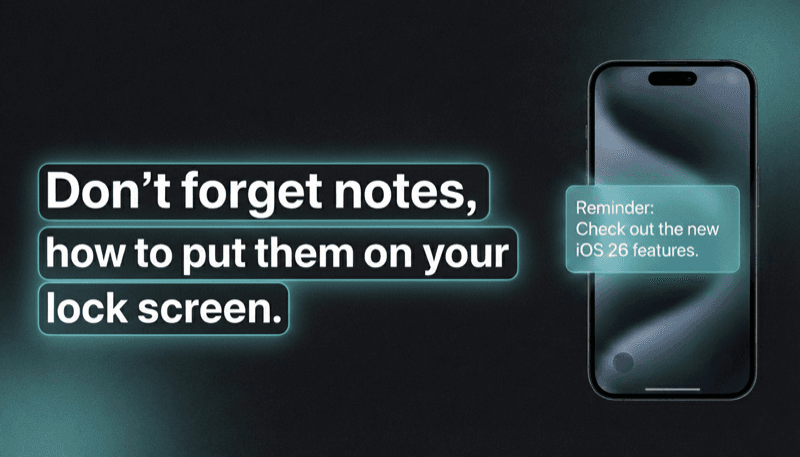
How to Show Reminders on iPhone Lock Screen (Without Notifications)
Want to see your tasks right on your lock screen? Learn how to display reminders on your iPhone lock screen without relying on notification banners.
How to Put Reminders on Lock Screen iPhone: The Ultimate Guide
Learn how to put reminders on your lock screen iPhone for maximum productivity! See your to-do list every time you glance at your phone. Use NoteWall!